


What makes an AI agent universal (truly plug-and-play)
Most AI agents are demos welded to one dataset. A universal agent drops into any business, speaks to any system, and is productive on day one. Here's the architecture that makes that real.

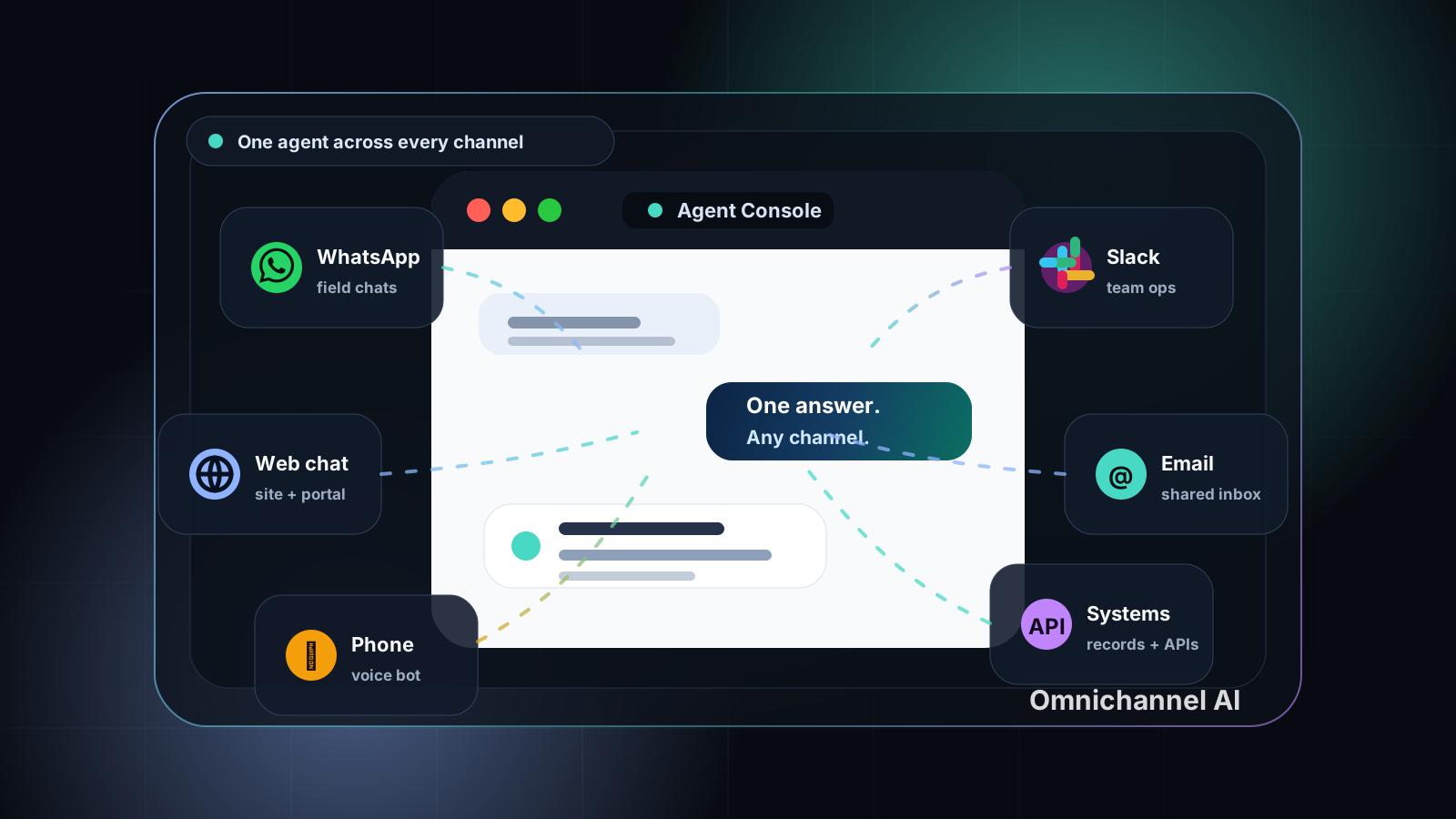
“Plug-and-play” is the most over-promised phrase in AI. Almost every agent demo looks universal until you try to point it at a second company — then it needs a month of re-wiring, a new prompt, and a fresh integration. Real plug-and-play means something harder and more valuable: the same agent drops into a new business, connects to whatever systems already exist, and starts doing useful work on day one.
After shipping agents into very different worlds — a police force querying case records, a finance team chasing receivables across phone, WhatsApp and email — we’ve learned that universality isn’t a feature you bolt on. It’s an architecture. Here’s what actually makes an agent portable.
Want a plug-and-play agent for your stack? Vak Agent is built to connect to your data, roles and workflows without rebuilding the product each time.
Explore Vak Agent →1. A connector layer, not a rewrite
The fastest way to kill portability is to hard-code the agent to one database or one API. A universal agent treats every data source — SQL, a REST API, a spreadsheet export, a message queue — as an adapter behind a common interface. Swapping the customer means swapping the adapter, not rebuilding the brain.
The agent’s reasoning shouldn’t know or care whether the answer came from MySQL or a vendor API. That separation is the difference between “we support your stack” and “give us six weeks.”
2. Schema-aware, not schema-locked
Every business models its world differently. One calls them “tickets,” another “cases,” another “accounts.” A universal agent learns the shape of your data at connect time — the tables, the relationships, the meaning of each field — instead of shipping with a frozen schema baked into its prompts.
This is what lets the same agent answer “show me overdue invoices by region” for one customer and “list FIRs with no arrest in this district” for another, without a developer rewriting a single query template.
3. Read-only and safe by default
You cannot make an agent universal if every deployment is a security negotiation. The default posture has to be safe: read-only access, parameterized and single-statement queries, and an agent that can retrieve and reason but never silently mutate data.
When safety is the floor rather than a custom add-on, onboarding a new customer stops being a risk review and starts being a configuration step. Guardrails that travel with the agent are guardrails you don’t have to renegotiate.
4. Actions and channels as abstractions
Answering a question is only half the job. A genuinely useful agent also acts — it sends a reminder, places a call, drafts an email, opens a ticket. The trick is to model each channel (chat, voice, WhatsApp, email) as an interchangeable tool, so adding “now do it over the phone” doesn’t mean rebuilding the agent.
A universal agent plans in terms of intents — “follow up with this account” — and lets the channel layer decide how. Voice today, a new messaging platform tomorrow, same logic underneath.
5. Context and memory per entity
Generic chatbots forget. A universal agent keeps a thread per entity — per account, per case, per customer — so it knows what was said last week and in which language. That memory is structural, not a single sprawling prompt, which means it scales to thousands of entities without losing the plot on any one of them.
6. Configurable roles, not hard-coded behavior
The same underlying agent should behave differently for a frontline operator, a supervisor, and an investigator — different data visibility, different suggested actions, different tone. When personas and permissions are configuration rather than code, one agent serves an entire organization instead of needing a bespoke build per role.
7. Observability and audit, everywhere
Trust is a precondition for “plug-and-play.” If a customer can’t see what the agent did — every query, every message, every outbound action, logged and reviewable — they won’t let it near production data. Audit and monitoring aren’t compliance theater; they’re what makes a new deployment defensible from day one.
8. Deploy anywhere
Finally, universality dies at the deployment step if there’s only one way to run it. Some customers want it self-hosted inside their own cloud; others want you to host, scale and maintain it. A portable agent ships as something you can run on your infrastructure or hand off as a managed service — same product, two operating models.
What “universal” really means
Put these together and a pattern emerges. A universal agent isn’t a bigger model or a cleverer prompt. It’s a thin, opinionated reasoning core wrapped in swappable layers: connectors for data, tools for actions, configuration for roles, and guardrails and audit that travel with it everywhere.
That’s the bar we hold ourselves to with Vak Agent. The same agent that reads case records for a police force runs receivables collection for a finance team — not because we rebuilt it twice, but because it was built to plug in once and play anywhere.
Want an agent that plugs into your data?
See Vak Agent in production.