

Why omnichannel agents beat ordinary chatbots
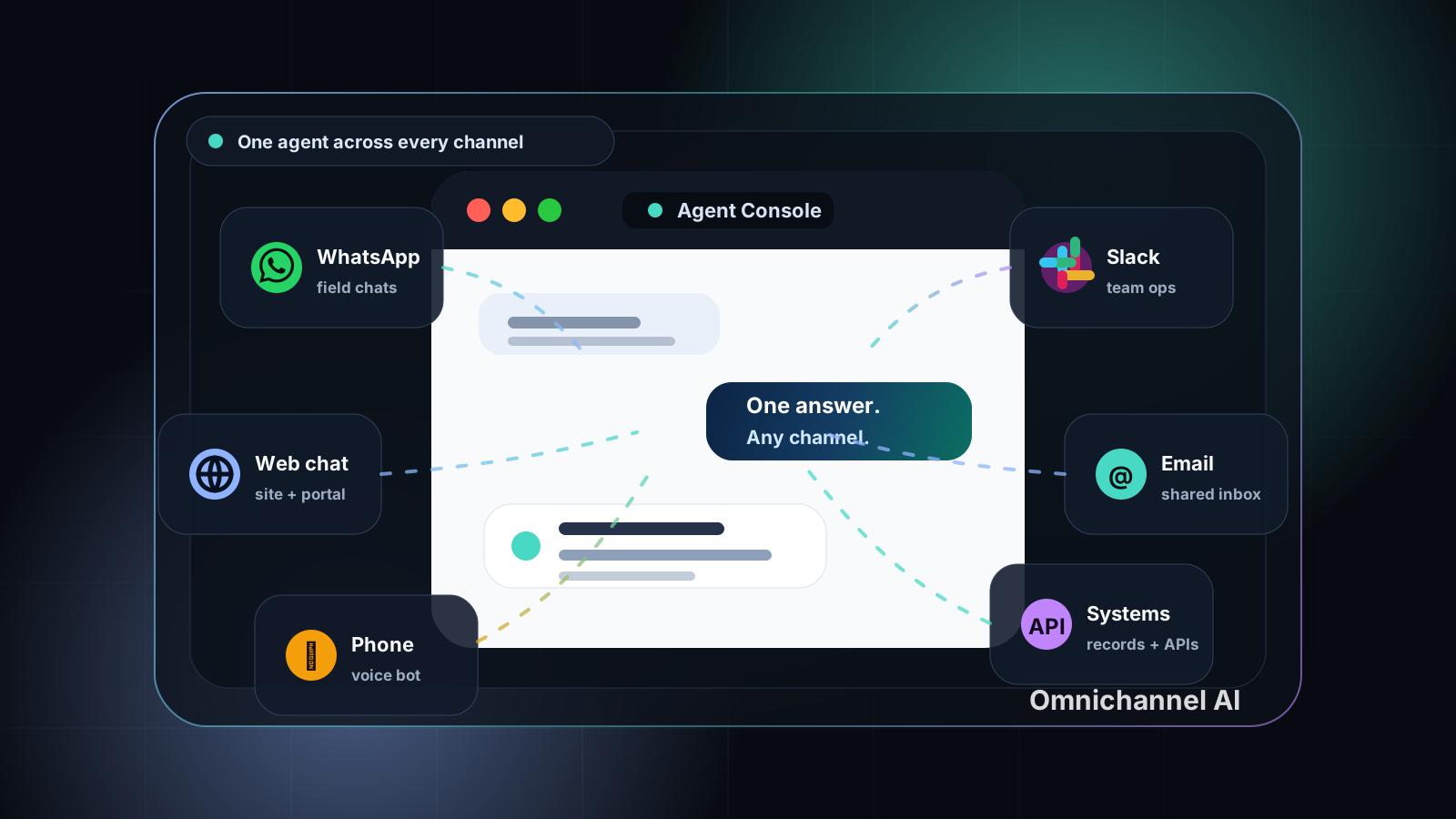
A chatbot answers in one box. Vak Agent meets teams across web, WhatsApp, phone calls, email and Slack — with a multimodal voice pipeline and proactive outreach behind one governed brain.

Most business chatbots are trapped inside the widget they launched in. They can answer a question on a website, maybe route a ticket, and then the conversation ends where it started. That is useful for a narrow support flow, but it is not how real work happens.
Real work jumps channels. A customer sends a WhatsApp message. A manager asks in Slack. A field operator prefers a phone call. Someone forwards an email with half the context missing. If the agent only works in one place, the team ends up copying, pasting and re-explaining the same problem across tools.
Vak Agent is built around a different idea: one governed brain, available wherever the workflow naturally happens.
See the omnichannel agent product. Vak Agent connects web chat, WhatsApp, phone calls, email and Slack to one governed AI layer.
Explore Vak Agent →The channel should not change the answer
If a user asks about an overdue account in WhatsApp, a case record on the website, or a status update in Slack, the agent should draw from the same data, permissions and audit trail. The answer should not become less reliable just because the question arrived from a different surface.
That is why channel handling needs to sit outside the reasoning core. The agent should decide what needs to be done, then the channel layer should decide how to deliver it.
Website chat is the front door
The website or internal portal is usually the easiest place to start. It gives teams a clear interface to ask questions, review grounded answers, and explore what the agent can do before expanding into other channels.
For operations teams, this is often the control surface: ask about records, inspect the evidence, export the result, and decide what action should happen next.
WhatsApp reaches the field
WhatsApp matters because many workflows do not happen at a desk. Field teams, customers and operators often respond faster in a messaging app than in a portal. An agent that can work over WhatsApp can send reminders, answer status questions, and keep the thread tied to the same underlying account, case or record.
The key is not simply sending messages. The key is keeping the conversation grounded in the same source of truth.
Phone calls make agents accessible
Some users will never type into a chatbot. They will call.
Voice support lets someone talk to the agent naturally, hear a response, and have the conversation logged like any other channel. For collections, support triage, reminders or field operations, phone calls can be the difference between an ignored workflow and a completed one.
Voice should not be a separate product bolted on later. It should be another channel on top of the same agent.
Under the hood, Vak Agent’s voice is a fully multimodal pipeline. Speech-to-text, reasoning, and text-to-speech are separate, swappable stages — much like LiveKit’s agent architecture — so you can plug in the providers that fit your language, latency and cost needs. Cartesia, Sarvam, ElevenLabs and others all drop into the same pipeline, and the reasoning core never has to change to support a new voice. For Indian languages in particular, that flexibility is the difference between a demo and a phone call a customer actually wants to take.
Proactive outreach, not just inbound answers
An omnichannel agent should not only wait to be asked. The most valuable workflows are often outbound: nudging a dealer toward a live sales scheme before the deadline, reminding a customer about an overdue balance, or following up after a missed milestone.
Because the agent plans in terms of intent — “follow up with this account” — and the channel layer decides how, the same agent that answers questions on the website can pick up the phone or send a WhatsApp message to push the next action forward. That turns the agent from a reactive help desk into something closer to a teammate who works the funnel.
Email and Slack serve internal teams
Email is still where a lot of business context lives. Slack is where many internal teams coordinate. If the agent can work across both, it can answer repeated questions, draft grounded replies, and escalate issues without forcing people to abandon their existing workflow.
This is where Vak Agent starts to compete with enterprise AI search tools: it does not only retrieve information, it can also act on it through the channels the business already uses.
Omnichannel only works with governance
More channels also mean more risk. Every answer, message and action needs to respect permissions. Every outbound step needs to be logged. Every workflow needs enough audit detail that a team can trust what happened later.
That is why Vak Agent treats security, roles and audit as product foundations rather than deployment extras.
The product is the operating layer
The goal is not to create five disconnected bots. The goal is to create one operating layer that can answer, follow up and escalate across channels.
That is the difference between an ordinary chatbot and an omnichannel agent. The chatbot waits in one box. The agent follows the work.
Want an agent that plugs into your data?
See Vak Agent in production.